Our Pick: Pedia-Lax
Check price on Amazon →The Best Suppositories for Kids: Two Shelves, Kept Apart
There are two completely different children's suppositories and they get confused constantly. Glycerin, for occasional constipation, is a laxative and not a drug the body absorbs. Acetaminophen, for fever and pain, is absorbed and has a real ceiling. Pedia-Lax Liquid Glycerin, 6 for $12.81, leads the first shelf; FeverAll Infant 80 mg, 6 for $12.73, leads the second. The pediatrician decides which shelf a child is on. Prices verified via the Amazon Creators API on September 5, 2026.
By The Pharmacy Desk2026-09-05~12 min read Ranked on verified label facts, never box claimsHow we research
For a constipated child aged 2 to 5, buy Pedia-Lax Liquid Glycerin Suppositories, 6 count, at $12.81 (verified via the Amazon Creators API on September 5, 2026), about $2.14 per applicator. For a feverish child who cannot keep oral medicine down, buy FeverAll Infant Acetaminophen Suppositories, 80 mg, at $12.73 for 6, about $2.12 each, or the 120 mg children's strength at $15.09 if that is the strength your pediatrician named. Those are two different products for two different problems, and the rest of this page exists to keep them from being mixed up.
The confusion is understandable. Both are small, bullet-shaped, foil-wrapped things you insert rectally into a child who does not want you to. Everything past that is different. A glycerin suppository is hyperosmotic: it draws water into the lower bowel, softens stool, and is not meaningfully absorbed into the body, which is why the label talks about minutes rather than milligrams. An acetaminophen suppository is a drug delivered through the rectal lining into the bloodstream, with a strength printed in milligrams and a genuine daily ceiling. Giving the wrong one does not just fail to help; on the fever side, doubling up with an oral product is how accidental overdose happens.
How we ranked: every listing was verified live through the Amazon Creators API on September 5, 2026. We recorded the strength and count where the listing title states them, computed cost per use only where both are published, and carried each Drug Facts panel's age lines exactly as printed. We print no dose, no interval and no daily maximum for the acetaminophen products, because those live on the box. On every children's page here the pediatrician decides: whether to treat, which shelf, and which strength. We are a research and verification desk, not clinicians, nothing here is medical advice, no brand paid for a placement, and if you buy through a link we may earn an Amazon commission at no cost to you.
The short version
- Constipation shelf, Our Pick: Pedia-Lax Liquid Glycerin, 6 for $12.81, about $2.14 per applicator. Labeled for ages 2 to 5; under 2, ask a doctor.
- Fever shelf, top pick: FeverAll Infant 80 mg, 6 for $12.73, about $2.12 each. The 120 mg children's strength is $15.09 for 6. Buy the milligram number your pediatrician names.
- Cheapest per use on the page: Quality Choice Pediatric Suppositories, 25 for $10.00, about 40 cents each, if a solid pediatric glycerin suppository is what you want.
- Best value if you will need more than one box: the Pedia-Lax 3-pack, 18 applicators for $21.11, about $1.17 each, roughly half the single box per unit.
- Never give an acetaminophen suppository alongside an oral acetaminophen product. It is the same drug and the amounts add together.
At a glance
| Product | What it is for | Active | Label ages | Count | Cost per use | Price (9/5/26) | Check price |
|---|---|---|---|---|---|---|---|
| Pedia-Lax Liquid Glycerin, 6 ct | Occasional constipation | Glycerin | 2 to 5; under 2 ask a doctor | 6 | $2.14 | $12.81 | Check price on Amazon |
| Rising Health Children's Glycerin 1.2 g | Occasional constipation | Glycerin 1.2 g | 2 to 5 (per title) | Not published | Not computed | $9.99 | Check price on Amazon |
| Quality Choice Pediatric Suppositories, 25 ct | Occasional constipation | Glycerin | Per the panel | 25 | $0.40 | $10.00 | Check price on Amazon |
| FeverAll Infant, 80 mg | Fever and pain | Acetaminophen 80 mg | Infant; directions on the box | 6 | $2.12 | $12.73 | Check price on Amazon |
| FeverAll 120 mg (titled Infant) | Fever and pain | Acetaminophen 120 mg | Children's; directions on the box | 6 | $2.52 | $15.09 | Check price on Amazon |
| Enemeez Kids Mini-Enema | Occasional constipation | Docusate sodium | 2 to 12 (per title) | Not published | Not computed | $14.97 | Check price on Amazon |
| Pedia-Lax Liquid Glycerin, 6 ct x 3 | Occasional constipation | Glycerin | 2 to 5; under 2 ask a doctor | 18 | $1.17 | $21.11 | Check price on Amazon |
The children's suppository shelf, split by what the product is for. Strengths, counts and label ages are as stated on the Drug Facts panel or the listing title; where a title does not state a count we print not published and compute nothing. Prices verified via the Amazon Creators API on September 5, 2026.

Pedia-Lax Liquid Glycerin Suppositories, 6 count
Pedia-Lax
The pre-filled pediatric applicator, labeled ages 2 to 5, about $2.14 each.
Our verdict: The easiest children's constipation product to actually use, which on a resisting three year old is most of the battle. Its Drug Facts label covers exactly the 2 to 5 age band parents are usually shopping for, the applicator is pre-filled and single use, and there is nothing to unwrap, warm or aim beyond the tip. It costs more per use than a solid suppository and it is worth it.
Verified: Labeled active: glycerin, in a single-use pre-filled applicator. Uses: relief of occasional constipation, generally producing a bowel movement in 15 minutes to 1 hour per the panel. Directions: children 2 to 5 years; under 2, ask a doctor. Live at $12.81 for 6 on Amazon, verified via the Creators API on September 5, 2026, about $2.14 per applicator.
What the label covers. Pedia-Lax Liquid Glycerin Suppositories are made by Fleet, the same house as the adult glycerin jar, and the Drug Facts panel states relief of occasional constipation with a bowel movement generally in 15 minutes to 1 hour. The directions cover children 2 to 5 years, one applicator, and send children under 2 to a doctor. That age band is the reason this is the default recommendation on this page.
Format matters more than the price gap here. Owners describe the pre-filled applicator as the difference between a two minute job and a wrestling match, because there is no solid to warm in your fingers and nothing to drop. At $12.81 for 6 you pay about $2.14 per use against about 40 cents for a solid pediatric suppository, and for most parents that trade is worth making once or twice a year. If more than one box is likely, the 3-pack at $21.11 for 18 is about $1.17 each.
Stop lines, from the label: rectal bleeding or no bowel movement after use means stop and ask a doctor, and no laxative for more than 1 week without one. Deeper reading: best glycerin suppositories for kids covers this shelf in full, the Pedia-Lax review covers the whole line, and how to use a rectal suppository covers the mechanics.
Who should buy it
Buy this for a child aged 2 to 5 whose pediatrician has said an occasional glycerin laxative is appropriate, especially if a previous attempt with a solid suppository went badly. It is the format most parents find they can actually complete.
What we don't like
About $2.14 per use is the second highest cost per use on the constipation side of this page, the box holds only 6, and the label stops at age 5, so a 7 year old is not covered by it. Nothing about it helps a child under 2 without a doctor's direction.
- Active ingredient
- Glycerin
- Strength
- Stated on the Drug Facts panel, not in the listing title
- Count
- 6 applicators
- Form
- Pre-filled single-use liquid applicator
- Label ages
- 2 to 5 years; under 2, ask a doctor
- Cost per use
- $2.14 ($12.81 divided by 6)
- Packaging
- Individually sealed applicators in a carton
What we like
- Label covers exactly the 2 to 5 band most parents are shopping for
- Pre-filled applicator is the easiest format to use on a resisting child
- Made by Fleet, the same house as the adult glycerin line
- Single use and sealed, so nothing to store half opened
Worth noting
- About $2.14 per use, against 40 cents for a solid pediatric suppository
- Only 6 per box
- Label stops at age 5, with nothing for older children

Rising Health Children's Glycerin Suppositories, 1.2 g
Rising Health
A solid pediatric glycerin suppository that prints both 1.2 g and ages 2 to 5.
Our verdict: The clearest solid pediatric suppository on the shelf, because it prints the two facts a parent actually needs in the title itself: 1.2 g of glycerin, ages 2 to 5. If your pediatrician described a small solid suppository rather than an applicator, this is the box that leaves the least to guess at. Its count is not published, which is the one gap.
Verified: Labeled active: glycerin 1.2 g per pediatric suppository, rectal laxative for children ages 2 to 5 years, both stated in the listing title. Count is not published in the title, so no cost per use is computed. Live at $9.99 on Amazon, verified via the Creators API on September 5, 2026.
Two facts, printed where you can see them. Rising Health Children's Glycerin Suppositories state 1.2 g and ages 2 to 5 years in the listing title. Pediatric glycerin suppositories are generally made in a roughly 1 to 1.2 g size against the adult 2 g, so this is a full pediatric strength and not a fraction of an adult one. The count is not published in the title, so we compute no cost per use for it.
Rising also sells the same pediatric size under its Proctozone-G children's name at $8.49, which is the cheaper of the two listings at our September 5, 2026 check for what the titles describe as the same 1.2 g pediatric product. Neither publishes a count, so compare them on price alone and check the count on the listing page before ordering.
Who should buy it
Buy this if you want a solid pediatric glycerin suppository rather than an applicator and you want the strength and age range stated plainly. It is the least ambiguous solid on this page.
What we don't like
The count is not published in the listing title, so there is no honest cost per use, and $9.99 buys an unknown quantity. A solid suppository is also harder work on an uncooperative child than a pre-filled applicator.
- Active ingredient
- Glycerin
- Strength
- 1.2 g per suppository (stated in the title)
- Count
- Not published in the listing title
- Form
- Solid pediatric rectal suppository
- Label ages
- 2 to 5 years (stated in the title)
- Cost per use
- Not computed, count not published
- Packaging
- Carton
What we like
- Prints 1.2 g and ages 2 to 5 in the listing title itself
- A full pediatric strength rather than a piece of an adult suppository
- Cheaper up front than the pre-filled applicator box
Worth noting
- Count is not published, so cost per use cannot be computed
- Solid format is harder to use on a resisting child than an applicator
- Sold under two names at two prices, which invites confusion

Quality Choice Pediatric Suppositories, 25 count
Quality Choice
Twenty-five pediatric glycerin suppositories for $10.00, about 40 cents each.
Our verdict: The value option on the constipation shelf and the only one here with a published count high enough to matter: 25 suppositories for $10.00, about 40 cents each. It is a plain generic in plain packaging with a strength that the title does not print, so read the panel when it arrives.
Verified: Pediatric glycerin suppositories, 25 per package per the listing title. Strength is not stated in the title; the Drug Facts panel on the carton states it. Live at $10.00 on Amazon, verified via the Creators API on September 5, 2026, about 40 cents per suppository.
The arithmetic. Quality Choice Pediatric Suppositories are $10.00 for 25, which is about 40 cents each against about $2.14 for a Pedia-Lax applicator. For a household where a pediatrician has said this will be needed more than once, that gap is the strongest argument on the page for a solid suppository.
Quality Choice also lists infant glycerin suppositories, 25 count each in a 2-pack, at $12.03, about 24 cents each, which is the cheapest per unit anywhere on this site's pediatric shelf. Infant in a product name does not override the directions, though: pediatric glycerin labels send children under 2 to a doctor, and for a baby that call comes first. Our constipation relief for babies page covers that end of the shelf.
Who should buy it
Buy this if cost per use is the deciding factor and a solid suppository is acceptable, particularly where the pediatrician has said occasional use is likely to recur. It is the cheapest way to keep the constipation shelf stocked.
What we don't like
The listing title does not publish the glycerin strength, the packaging is generic, and a solid suppository is harder to administer than an applicator. Quality Choice is a value house rather than a pharmacy brand with a pediatric line behind it.
- Active ingredient
- Glycerin
- Strength
- Not published in the listing title; stated on the panel
- Count
- 25
- Form
- Solid pediatric rectal suppository
- Label ages
- Per the Drug Facts panel on the carton
- Cost per use
- $0.40 ($10.00 divided by 25)
- Packaging
- Carton
What we like
- About 40 cents per suppository, the lowest computable cost per use here
- 25 per package, enough that a box lasts
- Simple pediatric glycerin with no added actives
Worth noting
- Strength is not published in the listing title
- Generic packaging and a value brand rather than a pediatric specialist
- Solid format, so harder work than the pre-filled applicator

FeverAll Infant Acetaminophen Suppositories, 80 mg
FeverAll
The 80 mg infant strength, for a feverish baby who cannot keep syrup down.
Our verdict: A completely different product from everything above it on this page, and the reason the page is organised the way it is. This is a drug, absorbed into the bloodstream, with a strength in milligrams and a real ceiling. It exists for the child who is vomiting or refusing, and it belongs in the fridge before you need it rather than in a pharmacy at 2 a.m.
Verified: Labeled active: acetaminophen 80 mg per rectal suppository, pain reliever and fever reducer, 6 per box per the listing title. Live at $12.73 on Amazon, verified via the Creators API on September 5, 2026, about $2.12 per suppository.
Different shelf, different rules. FeverAll Infant Acetaminophen Suppositories deliver 80 mg of acetaminophen through the rectal lining, 6 per box at $12.73. Where a glycerin suppository works locally and is measured in minutes, this one is measured in milligrams and adds to every other acetaminophen product in the house.
One buying trap worth repeating from our acetaminophen suppository guide: Amazon's FeverAll titles do not track the strength ladder. The 120 mg listing is titled with the word Infant, and the 325 mg listing with the word Children. Match the milligram number your pediatrician gave you, never the word.
Who should buy it
Buy this for a household with a baby or young toddler, in advance of needing it, once a pediatrician has discussed how you would handle a fever in a child who cannot keep medicine down. It is the infant strength, and it is what the rectal route is for.
What we don't like
About $2.12 per suppository is expensive against a bottle of oral suspension holding many doses, the box holds 6, and it needs cool storage. It is also the product on this page most likely to be bought at the wrong strength thanks to Amazon's titles.
- Active ingredient
- Acetaminophen
- Strength
- 80 mg per suppository
- Count
- 6
- Form
- Rectal suppository, individually foil wrapped
- Label ages
- Infant strength; age range and directions are printed on the box
- Cost per suppository
- $2.12 ($12.73 divided by 6)
- Packaging
- Foil strip in a carton
What we like
- The infant strength, 80 mg, printed on the box
- Works when a child cannot keep oral medicine down
- Individually foil wrapped, so a partial box keeps
Worth noting
- About $2.12 per suppository
- Six per box, which a multi-day fever can run through
- Adds to any other acetaminophen product in the house, so it needs care
FeverAll Acetaminophen Suppositories, 120 mg
FeverAll
The 120 mg children's strength, listed on Amazon under the wrong word.
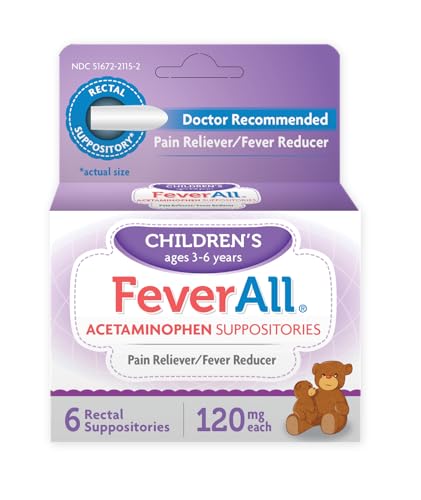
Our verdict: The next rung up from the infant box, at 120 mg, and the listing most likely to be bought by accident because Amazon titles it with the word Infant. If a pediatrician named 120 mg, this is the box. If they named 80 mg, it is not, and no amount of reassuring wording in the title changes that.
Verified: Labeled active: acetaminophen 120 mg per rectal suppository, 6 per box per the listing title. Live at $15.09 on Amazon, verified via the Creators API on September 5, 2026, about $2.52 per suppository.
Read the number. This FeverAll listing is 120 mg per suppository, 6 to a box at $15.09, about $2.52 each. FeverAll's ladder runs 80 mg infant, 120 mg children's, 325 mg junior. Amazon's title for this one says Infant. The milligram figure is the fact; the descriptive word is not.
If 120 mg is your strength and you want a spare carton somewhere else, the two-pack at $26.99 for 12 works out to about $2.25 each, which is cheaper per suppository than the single box. Full head to head against the infant strength: FeverAll infant vs children's.
Who should buy it
Buy the 120 mg box for a child whose pediatrician has named that strength and who cannot keep oral medicine down. It is the correct middle rung between the infant and junior boxes.
What we don't like
The Amazon title says Infant, which is the worst possible error on a shelf where the milligram number is the whole decision. At about $2.52 per suppository it is also the priciest single box in the FeverAll line.
- Active ingredient
- Acetaminophen
- Strength
- 120 mg per suppository
- Count
- 6
- Form
- Rectal suppository, individually foil wrapped
- Label ages
- Children's strength; age range and directions are printed on the box
- Cost per suppository
- $2.52 ($15.09 divided by 6)
- Packaging
- Foil strip in a carton
What we like
- The children's strength, 120 mg, printed on the panel
- Two-pack version brings the cost down to about $2.25 each
- Same individually wrapped format as the infant box
Worth noting
- Amazon titles it with the word Infant despite the 120 mg strength
- About $2.52 per suppository, the highest single-box cost in the line
- Six per box

Enemeez Kids Mini-Enema
Enemeez
A docusate sodium mini-enema for ages 2 to 12, when a suppository is not enough.
Our verdict: Not a suppository, and included because parents comparing children's constipation products keep landing on it. The Enemeez mini-enema uses docusate sodium in a small single-use unit and its title covers ages 2 to 12, a wider band than any pediatric glycerin product here. It is a step up in intervention and belongs in a pediatrician's plan rather than a self-directed one.
Verified: Labeled active: docusate sodium, in a single-use mini-enema for ages 2 to 12 per the listing title. Count is not published in the title, so no cost per use is computed. Live at $14.97 on Amazon, verified via the Creators API on September 5, 2026.
What it is. Enemeez Kids is a mini-enema rather than a suppository: a small single-use unit whose active is docusate sodium, a stool softener, with the listing title stating ages 2 to 12. That age band is why it appears on a page otherwise dominated by products that stop at 5.
The count is not published in the listing title, so we compute no cost per use. Enemeez also lists a DocuSol Enemeez Kids version at $14.79. For the full enema picture, including the Fleet and Pedia-Lax children's saline enemas, see best enemas for kids and Pedia-Lax vs Fleet children's enema.
Who should buy it
Consider it when a pediatrician has specifically discussed a mini-enema, or for a child aged 6 to 12 who has aged out of the pediatric glycerin labels. It is the widest age band on this page.
What we don't like
The count is not published, so there is no cost per use, and it is a bigger intervention than a glycerin suppository for a problem that often does not need one. Two near-identical listings at two prices makes the shelf harder to read.
- Active ingredient
- Docusate sodium
- Strength
- Stated on the Drug Facts panel, not in the listing title
- Count
- Not published in the listing title
- Form
- Single-use mini-enema
- Label ages
- 2 to 12 (stated in the title)
- Cost per use
- Not computed, count not published
- Packaging
- Single-use units
What we like
- Covers ages 2 to 12, wider than any pediatric glycerin label here
- Single-use units, nothing to measure or mix
- A genuine option when a suppository has not worked and a doctor agrees
Worth noting
- Count is not published, so no cost per use can be computed
- A larger intervention than a suppository for the same complaint
- Sold under two closely related listings at different prices

Pedia-Lax Liquid Glycerin Suppositories, 6 count, 3-Pack
Pedia-Lax
Eighteen pediatric applicators for $21.11, about $1.17 each.
Our verdict: The same applicator as our top pick at roughly half the price per use: 18 for $21.11, about $1.17 each against $2.14. If a pediatrician has told you this will be a recurring tool rather than a one-off, buy this instead of the single box and stop thinking about it.
Verified: Labeled active: glycerin in a pre-filled pediatric applicator, three boxes of 6 for 18 total per the listing title, ages 2 to 5. Live at $21.11 on Amazon, verified via the Creators API on September 5, 2026, about $1.17 per applicator.
The saving is unusually large. The Pedia-Lax 3-pack is $21.11 for three boxes of 6, so 18 applicators at about $1.17 each. The single box is $12.81 for 6, about $2.14. That is close to a 45 percent drop per use for the identical product, which is a bigger multipack gap than anything on the fever side of this page.
Fleet also sells a bundle of the 3-pack with the chewable tablets at $38.09 for households that want the oral option beside the rectal one. The chewables are covered in best kids laxatives, and the whole Pedia-Lax range is in the Pedia-Lax review.
Who should buy it
Buy the 3-pack if a pediatrician has said occasional glycerin suppositories are likely to be needed more than once, or if you want a box at home and a box at a grandparent's. It is the cheapest way to get the applicator format.
What we don't like
It is $21.11 up front for a product used occasionally, three cartons means three expiry dates, and buying eighteen of anything can quietly encourage more use than the label supports.
- Active ingredient
- Glycerin
- Strength
- Stated on the Drug Facts panel, not in the listing title
- Count
- 18 applicators (three boxes of 6)
- Form
- Pre-filled single-use liquid applicator
- Label ages
- 2 to 5 years; under 2, ask a doctor
- Cost per use
- $1.17 ($21.11 divided by 18)
- Packaging
- Three cartons
What we like
- About $1.17 per applicator, roughly half the single box per use
- Identical product to our top pick, just bought in volume
- Three cartons lets you stock more than one location
Worth noting
- $21.11 up front for occasional use
- Three expiry dates to track
- Volume can tempt more use than the 1 week label line allows
What you'll need
The six things that go in the same cart as a suppository: the pharmacy-standard glycerin, a daily stool softener, an enema for the nights nothing else works, witch hazel wipes, sitz salts, and a barrier ointment. Prices are approximate at time of writing.


More picks worth comparing
Beyond this guide, the highest-rated picks across every category and budget, with a live price check on each.


As an Amazon Associate we earn from qualifying purchases, at no cost to you.
Quick shop: every pick
Skip the scroll: the whole lineup, with a live price check on each.
- Pedia-Lax Liquid Glycerin Suppositories, 6 countBest for Constipation, Ages 2 to 5Pedia-Lax · $12.81Check price on Amazon
- Rising Health Children's Glycerin Suppositories, 1.2 gBest Solid Pediatric SuppositoryRising Health · $9.99Check price on Amazon
- Quality Choice Pediatric Suppositories, 25 countLowest Cost per UseQuality Choice · $10.00Check price on Amazon
- FeverAll Infant Acetaminophen Suppositories, 80 mgBest for Fever, Infant StrengthFeverAll · $12.73Check price on Amazon
- FeverAll Acetaminophen Suppositories, 120 mgBest for Fever, Children's StrengthFeverAll · $15.09Check price on Amazon
- Enemeez Kids Mini-EnemaThe Mini-Enema AlternativeEnemeez · $14.97Check price on Amazon
- Pedia-Lax Liquid Glycerin Suppositories, 6 count, 3-PackBest Value on the Constipation ShelfPedia-Lax · $21.11Check price on Amazon
How we chose
We rank children's suppositories on what their labels state and what their listings publish, in this order: what the product is for, the active ingredient and strength, the age the Drug Facts panel covers, the count, the cost per use where both price and count are published, and the packaging, which on a pediatric product decides whether a parent can open it one handed. Every listing here was verified live through the Amazon Creators API on September 5, 2026. Owner reports were weighed only for the practical questions labels do not answer, such as how the Pedia-Lax applicator tip behaves and whether solid suppositories arrive soft.
Compliance for this page. Both shelves here are over-the-counter drugs, so we quote the label's Uses and Directions and nothing beyond them. The glycerin products carry the laxative stop lines: rectal bleeding, no bowel movement after use, and no laxative use beyond 1 week without a doctor. The acetaminophen products carry their own: any fever in an infant under 3 months is a call to the doctor before medicine is given, fever lasting more than 3 days is a call, and worsening symptoms are a call. We print no dose, no interval between doses and no weight-based amount for any acetaminophen product, because the box prints those and the box is the correct source. For any child, the pediatrician decides whether treatment is appropriate at all. Nothing here is medical advice.
Questions, answered
What suppository is best for a child with constipation?
For ages 2 to 5, Pedia-Lax Liquid Glycerin Suppositories, 6 for $12.81 at our September 5, 2026 check, about $2.14 per applicator. The Drug Facts label covers exactly that age band, the applicator is the easiest format on a child who does not want to cooperate, and glycerin is the gentle hyperosmotic option rather than a stimulant. If cost per use matters more than format, Quality Choice Pediatric Suppositories are 25 for $10.00, about 40 cents each. Either way the pediatrician decides whether a laxative is appropriate.
Can I use an adult glycerin suppository on a child?
The adult label does not permit it. Adult glycerin suppositories are 2 g and their Drug Facts directions cover adults and children 6 years and over, sending children under 6 to a doctor. They print no smaller dose and no instruction for splitting one, and neither do we. The pediatric products exist precisely so that nobody has to improvise: Rising Health prints 1.2 g and ages 2 to 5 in its own title. If a pediatrician directs something different for a specific child, that instruction is theirs to give.
What is the difference between a glycerin and an acetaminophen suppository?
Everything except the shape. Glycerin is a laxative that works locally in the lower bowel by drawing water in; it is not meaningfully absorbed, its label talks in minutes rather than milligrams, and it treats occasional constipation. Acetaminophen is a drug absorbed through the rectal lining into the bloodstream to reduce fever and pain; it has a milligram strength, a daily ceiling, and it adds to every other acetaminophen product a child is given. Mixing the two up is the single most common error on this shelf.
How long does a children's glycerin suppository take to work?
The Drug Facts panel on pediatric glycerin products states that a bowel movement generally follows in 15 minutes to 1 hour. That is the label's own window and it is what parents should plan around, which in practice means staying near a bathroom rather than starting the school run. If nothing happens after using the product, the label's instruction is to stop and ask a doctor rather than to try a second one.
Which FeverAll strength do I need?
The one your pediatrician names, and you should buy it by the milligram number rather than the word in the Amazon title. FeverAll makes 80 mg for infants, 120 mg for children and 325 mg for juniors. Amazon lists the 120 mg product with the word Infant in the title and the 325 mg product with the word Children, while both correctly print their milligram figure. Match the number in the title and in the Drug Facts panel photograph to the number you were given before buying.
Are suppositories safe for toddlers?
That is the pediatrician's call for a specific child, and every label on this page defers to it. What the labels do state is where their own coverage ends: pediatric glycerin suppositories are labeled for ages 2 to 5 and send children under 2 to a doctor, no enema is labeled for children under 2, and FeverAll prints its age directions on each box. Any fever in an infant under 3 months is a call to the doctor before medicine of any kind. Report the age line, follow the call.
How many suppositories can a child have?
Read the directions on the box you bought, because they differ by product and we will not print a number for you. What every laxative label here shares is a stop line: if there is no bowel movement after use, or if a laxative is needed for more than 1 week, stop and ask a doctor rather than using another. On the fever side the interval and the daily maximum are printed on the FeverAll carton, and the additional rule is absolute: never combine an acetaminophen suppository with an oral acetaminophen product.
Is a suppository or an oral laxative better for a child?
Different tools with different labels, and the choice usually depends on whether the child will take anything by mouth. A pediatric glycerin suppository is labeled for 15 minutes to 1 hour and works locally in the lower bowel. Oral options such as the Pedia-Lax chewable tablets carry their own age-banded directions on the box and work further up. Neither is a treatment for ongoing constipation; both labels are written for occasional use. Our best kids laxatives page compares the oral shelf in full.
Filed under Buyer's Guide
Part of Babies & Kids
Keep reading
Best Glycerin Suppositories for Kids (2026)
The constipation shelf in depth, with every pediatric label's age line and cost per use.
Best Acetaminophen Suppositories (2026)
The fever shelf: all three FeverAll strengths, the title trap, and cost per suppository.
Best Kids Laxatives (2026)
The oral side of the same problem: chewables, gummies, powders and the age lines.
Suppositories for Babies and Toddlers
Every age line on one page, for the reader whose child is under the label bands.