Our Pick: Quality Choice
Check price on Amazon →Baby Constipation Relief, Ranked: What Each Label Actually Allows
Under age 2 there is no laxative you can buy that does not send you to a doctor first, so this page ranks the shelf honestly: what each product is, what its label covers, what it costs, and where the phone call belongs. Quality Choice Infants Glycerin Suppositories, 50 for $12.03, is the pick once a pediatrician has approved a glycerin suppository. Prices verified via the Amazon Creators API on September 5, 2026.
By The Pharmacy Desk2026-09-05~11 min read Ranked on verified label facts, never box claimsHow we research
 Best Overall
Quality Choice Infants Glycerin Suppositories, 25 count, 2-Pack
Quality Choice · 4.3
$12.03
Once a pediatrician has said a glycerin suppository is appropriate for your baby, buy Quality Choice Infants Glycerin Suppositories, 25 count each in a 2-pack, at $12.03 (verified via the Amazon Creators API on September 5, 2026), about 24 cents per suppository, the cheapest per unit on this shelf. If the problem is gas rather than stool, the Frida Baby Windi Gas Passer, 20 count, at $24.92 is the mechanical, drug-free option at about $1.25 each. And once the child turns 2, the shelf opens up: Pedia-Lax Liquid Glycerin Suppositories at $12.81 for 6 are labeled for ages 2 to 5.
The honest headline for this page is that the under-2 shelf is not really a shopping decision. Pediatric glycerin suppository directions send children under 2 to a doctor. No enema on the market is labeled for a child under 2. Bisacodyl, the stimulant, has no pediatric product at all. What that leaves a parent with is a phone call and, after the phone call, a small number of products whose labels the pediatrician will work within. That is not a disappointing answer, it is the correct one, and any page that ranks baby laxatives as though the choice were yours alone is doing you a disservice.
So this guide does something slightly different from the rest of the site. It ranks what is actually on the shelf for a constipated or uncomfortable baby, and for each one it states plainly what the product is, what its label or its Supplement Facts panel covers, what it costs per use where the count is published, and which of the four categories it belongs to: a rectal glycerin product, a mechanical gas tool, a dietary supplement, or a product for older children entirely. Every listing was verified live through the Amazon Creators API on September 5, 2026. We are a research and verification desk, not clinicians, nothing here is medical advice, no brand paid for a placement, and if you buy through a link we may earn an Amazon commission at no cost to you.
The short version
- Our Pick, once the pediatrician approves it: Quality Choice Infants Glycerin Suppositories, 25 count each in a 2-pack, $12.03, about 24 cents per suppository.
- Every pediatric glycerin label sends children under 2 to a doctor, no enema is labeled under 2, and there is no pediatric bisacodyl product at all. The call comes first, every time.
- The Frida Baby Windi is for gas, not constipation. It is a drug-free mechanical tool, 20 for $24.92, about $1.25 each, and it makes no laxative claim.
- BioGaia at $17.58 and Mommy's Bliss Everyday at $17.97 are dietary supplements, not drugs. They are not approved to treat constipation, colic, gas or anything else.
- At age 2 the shelf changes: Pedia-Lax Liquid Glycerin, 6 for $12.81, is labeled for ages 2 to 5 and is the product most parents end up using.
At a glance
| Product | Category | What the label covers | Count | Cost per use | Price (9/5/26) | Check price |
|---|---|---|---|---|---|---|
| Quality Choice Infants Glycerin, 25 ct x 2 | OTC drug, glycerin | Occasional constipation; pediatric directions send under 2 to a doctor | 50 | $0.24 | $12.03 | Check price on Amazon |
| Frida Baby Windi Gas Passer, 20 ct | Device, drug free | Gas relief; not a laxative and makes no laxative claim | 20 | $1.25 | $24.92 | Check price on Amazon |
| BioGaia Baby Probiotic Drops | Dietary supplement | Not approved to treat any condition | Not published | Not computed | $17.58 | Check price on Amazon |
| Mommy's Bliss Baby Probiotic Drops Everyday | Dietary supplement | Not approved to treat any condition | Not published | Not computed | $17.97 | Check price on Amazon |
| Pedia-Lax Liquid Glycerin, 6 ct | OTC drug, glycerin | Occasional constipation, ages 2 to 5; under 2 ask a doctor | 6 | $2.14 | $12.81 | Check price on Amazon |
| Frida Baby Fart Freeing Essentials | Device plus belly rub | Gas relief; not a laxative | Not published | Not computed | $19.99 | Check price on Amazon |
The baby comfort shelf by category. Drug products carry a Drug Facts panel; supplements carry a Supplement Facts panel and are not approved to treat any condition. Counts and prices are as published on the listing on September 5, 2026, verified via the Amazon Creators API; where a count is not published we compute nothing.
Quality Choice Infants Glycerin Suppositories, 25 count, 2-Pack
Quality Choice
Fifty infant glycerin suppositories for $12.03, about 24 cents each.
Our verdict: The infant glycerin suppository that gives you the most for the least: 50 for $12.03, about 24 cents each, which is the cheapest per unit anywhere on this shelf. The word Infants is in the product name, and it does not override the directions. Pediatric glycerin labels send children under 2 to a doctor, so this is the box you buy after the call rather than instead of it.
Verified: Infant glycerin suppositories, laxative, 25 count each in a 2-pack for 50 total per the listing title. Strength is not stated in the title; the Drug Facts panel states it. Live at $12.03 on Amazon, verified via the Creators API on September 5, 2026, about 24 cents per suppository.
What you are buying. Quality Choice Infants Glycerin Suppositories are small solid glycerin suppositories, sold 25 to a package in a 2-pack, at $12.03 for 50. The listing title does not state the glycerin amount, so we print none; the Drug Facts panel on the carton does, and it is worth reading the day the box arrives.
Once that conversation has happened, this is a sensible box to own. Glycerin is hyperosmotic: it draws water into the lower bowel and softens what is there rather than stimulating the bowel wall, which is why it is the pediatric option and why there is no children's bisacodyl at all. The panel's window is generally 15 minutes to 1 hour, so plan to stay near a changing surface. Deeper coverage of this exact shelf is in best glycerin suppositories for infants, and every age line across the pediatric range is collected in suppositories for babies and toddlers.
Stop lines from the label, which for a baby all mean a call: rectal bleeding, no bowel movement after use, or any need to use a laxative for more than 1 week.
Who should buy it
Buy this once a pediatrician has said an occasional glycerin suppository is appropriate for your child and you want the lowest cost per use available. Fifty units is a supply that will outlast the episode, which is the point.
What we don't like
The listing title does not publish the glycerin amount, the packaging is plain generic, and the word Infants on the front is doing more marketing work than labeling work given what the directions say. Solid suppositories also soften in heat.
- Active ingredient
- Glycerin
- Strength
- Not published in the listing title; stated on the panel
- Count
- 50 (two packages of 25)
- Form
- Solid infant rectal suppository
- Label ages
- Pediatric glycerin directions send children under 2 to a doctor
- Cost per use
- $0.24 ($12.03 divided by 50)
- Packaging
- Two cartons
What we like
- About 24 cents per suppository, the cheapest per unit on this shelf
- Fifty units, so a single purchase outlasts the episode
- Plain glycerin with no added actives
- Two cartons lets you keep one at a second location
Worth noting
- Strength is not published in the listing title
- The name says Infants while the directions send under 2 to a doctor
- Generic packaging from a value house rather than a pediatric brand
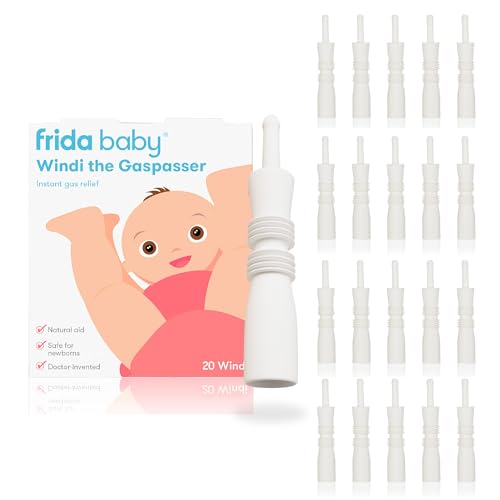
Frida Baby Windi Gas Passer, 20 count
Frida Baby
A single-use vent tube for trapped gas, drug free, about $1.25 each.
Our verdict: The most useful product on this page for the problem parents most often mistake for constipation, and we are going to be precise about it: the Windi is for gas. It is a small single-use vent tube with a stopper, it contains no medicine, and it makes no laxative claim. If your baby is straining and drawing up their legs but stools are normal, this is the tool. If stools are hard and infrequent, it is not.
Verified: Frida Baby Windi Gas Passer, baby gas relief for babies and infants, 20 count per the listing title. A single-use device, not a drug, with no active ingredient and no Drug Facts panel. Live at $24.92 on Amazon, verified via the Creators API on September 5, 2026, about $1.25 per Windi.
What it is and is not. The Frida Baby Windi is a short, soft, single-use tube with a stopper that limits how far it can go, designed to help a baby release trapped gas. It contains no drug, carries no Drug Facts panel, and it is not a laxative. We are saying that flatly because this page sits in a constipation guide and the distinction is the whole reason the product deserves an honest slot rather than a vague one.
At $24.92 for 20 this is about $1.25 per Windi, and they are single use by design. The smaller box is $12.74 and does not publish a count in its title, so we compute no per-unit figure for it. Owners consistently describe the stopper as the feature that makes them willing to try it at all, and consistently advise reading the instructions before the first use rather than during a crying fit. Our full write-up is the Frida Windi review.
Who should buy it
Buy the Windi if your baby's problem is trapped gas rather than hard stool, and you would rather use a mechanical tool than give a medicine. Twenty is the box that makes sense, because they are single use and gas is a recurring problem in the first months.
What we don't like
About $1.25 per single-use tube adds up quickly, it does nothing for actual constipation, and it is a device you insert into a baby, which many parents are not comfortable with and should not be talked into. Twenty count is also a $24.92 outlay to find out whether it suits you.
- Type
- Single-use gas relief device, drug free
- Active ingredient
- None; not a drug product
- Count
- 20
- Form
- Soft vent tube with a stopper
- Label ages
- Marketed for babies and infants; the packaging carries the usage guidance
- Cost per use
- $1.25 ($24.92 divided by 20)
- Packaging
- Box of individually packed single-use units
What we like
- Drug free, so nothing is absorbed and nothing interacts
- The stopper limits insertion depth, which is why parents will try it
- Single use and sealed, nothing to clean
- Twenty per box at about $1.25 each
Worth noting
- For gas only; it is not a laxative and does nothing for hard stool
- About $1.25 every time you use one
- The smaller box does not publish its count in the title

BioGaia Baby Probiotic Drops
BioGaia
The most recognised baby probiotic drops, a dietary supplement, not a medicine.
Our verdict: The best-known name in baby probiotic drops and the one most parents have had recommended to them by another parent. It is a dietary supplement, which means it is not approved to treat constipation, colic, gas or any other condition, and the colic and gas wording in the listing title is the maker's marketing, not a cleared claim. Judged as a supplement rather than a medicine, it is the credible one.
Verified: BioGaia Baby Probiotic Drops, a dietary supplement carrying a Supplement Facts panel. The bottle volume and number of servings are not published in the listing title, so no cost per serving is computed. Live at $17.58 on Amazon, verified via the Creators API on September 5, 2026.
What it is, in the correct category. BioGaia Baby Probiotic Drops are a dietary supplement with a Supplement Facts panel, not an over-the-counter drug with a Drug Facts panel. That difference is not a technicality. A drug has been reviewed for a stated use; a supplement has not, and cannot be sold as treating anything.
Practically, parents use drops like these on a pediatrician's suggestion or on a friend's, usually alongside rather than instead of everything else on this page. The listing title does not publish the bottle volume or the number of servings, so we compute no cost per serving. Give them to your pediatrician's plan rather than to the internet's, keep them stored as the bottle directs, and treat the dropper as the only measuring device for the product. The alternative on this page is Mommy's Bliss Everyday, and both are covered in depth in best baby probiotic drops.
Who should buy it
Buy BioGaia if your pediatrician has suggested a probiotic and you want the most recognised name on the shelf. It suits parents who want to try something gentle and non-drug while the underlying question is being worked out.
What we don't like
It is a supplement, so nothing about its effect on constipation has been evaluated, and at $17.58 with no published serving count there is no way to compute what a day of it costs. The colic and gas wording in the title sets an expectation the category cannot legally promise.
- Type
- Dietary supplement, Supplement Facts panel
- Active ingredient
- See the Supplement Facts panel; not a drug active
- Count
- Bottle volume and servings not published in the listing title
- Form
- Liquid drops with a dropper
- Label ages
- Marketed for newborns and up; follow the panel
- Cost per serving
- Not computed, servings not published
- Packaging
- Bottle with dropper
What we like
- The most recognised baby probiotic drop brand on the shelf
- Drug free and non-rectal, so it is the least invasive thing here
- Simple dropper format
Worth noting
- A dietary supplement, not approved to treat constipation or anything else
- Serving count not published, so cost per serving cannot be computed
- $17.58 for an outcome no label is allowed to promise

Mommy's Bliss Baby Probiotic Drops Everyday
Mommy's Bliss
The other supermarket-shelf probiotic drop, also a supplement, also unproven here.
Our verdict: Effectively a coin flip against BioGaia on everything a label can tell you, at 39 cents more. It is a dietary supplement, its listing title carries gas, constipation and colic language that is the maker's marketing rather than an approved claim, and nothing about it has been evaluated for treating anything. Buy it if it is the one your pediatrician mentioned or the one you can get.
Verified: Mommy's Bliss Baby Probiotic Drops Everyday, a dietary supplement carrying a Supplement Facts panel, marketed for newborns and up. Bottle volume and servings are not published in the listing title, so no cost per serving is computed. Live at $17.97 on Amazon, verified via the Creators API on September 5, 2026.
Same category, same caveats. Mommy's Bliss Baby Probiotic Drops Everyday are a dietary supplement with a Supplement Facts panel, at $17.97 against BioGaia's $17.58. The Amazon listing title includes the words gas, constipation and colic. Those are the maker's words in a marketing title, not a claim any supplement is permitted to make, and this page will not repeat them as one.
Choosing between the two is genuinely close. BioGaia has the larger reputation among parents and the more recognisable name in pediatric offices; Mommy's Bliss is easier to find in a supermarket and sells a wider baby range. Neither publishes a serving count in its title, so neither gets a cost per serving here. If you want the comparison in full, including how we rank a category where efficacy claims are not available, read best baby probiotic drops.
Who should buy it
Buy Mommy's Bliss if it is what your pediatrician named, what your store carries, or what you already trust from the brand's other baby products. As a supplement decision it is a reasonable one; as a constipation decision it is not one the label supports.
What we don't like
The listing title stacks gas, constipation and colic into a supplement name, which is the sort of wording that makes parents expect a medicine. No serving count is published, and at $17.97 it is the more expensive of the two drops here.
- Type
- Dietary supplement, Supplement Facts panel
- Active ingredient
- See the Supplement Facts panel; not a drug active
- Count
- Bottle volume and servings not published in the listing title
- Form
- Liquid drops
- Label ages
- Marketed for newborns and up; follow the panel
- Cost per serving
- Not computed, servings not published
- Packaging
- Bottle with dropper
What we like
- Widely available and from a brand with a broad baby range
- Drug free and non-rectal
- Priced within 39 cents of the category leader
Worth noting
- A dietary supplement, not approved to treat constipation, gas or colic
- Listing title's condition words set an expectation the category cannot support
- Serving count not published, so cost per serving cannot be computed

Pedia-Lax Liquid Glycerin Suppositories, 6 count
Pedia-Lax
The pre-filled applicator labeled for ages 2 to 5, about $2.14 each.
Our verdict: The product most parents on this page will eventually own, and the reason it appears in a baby guide is the handoff: on the day a child turns 2 the label finally covers them by name. Until then this box is the same ask a doctor as everything else. After then it is the easiest pediatric constipation product to use, and worth the premium over a solid suppository.
Verified: Labeled active: glycerin, in a single-use pre-filled applicator. Uses: relief of occasional constipation, generally a bowel movement in 15 minutes to 1 hour per the panel. Directions: children 2 to 5 years; under 2, ask a doctor. Live at $12.81 for 6 on Amazon, verified via the Creators API on September 5, 2026, about $2.14 per applicator.
The age line is the product. Pedia-Lax Liquid Glycerin Suppositories are made by Fleet and their Drug Facts directions cover children 2 to 5 years, sending children under 2 to a doctor. For a parent of a baby, that means this is the box you grow into rather than the box you start with, which is exactly why it sits fifth on a page about babies.
At $12.81 for 6 this is about $2.14 per applicator; the 3-pack is $21.11 for 18, about $1.17 each. Same stop lines as every laxative here: rectal bleeding, no bowel movement after use, or use beyond 1 week means stop and ask a doctor. Full coverage of the age 2 to 5 shelf is in best glycerin suppositories for kids, and the brand's whole range is in the Pedia-Lax review.
Who should buy it
Buy this for a child who has turned 2, once the pediatrician has agreed an occasional glycerin laxative is appropriate. It is the format most parents find they can actually complete, and the label covers the age band by name.
What we don't like
It does nothing for the reader whose child is under 2, which is most of the audience for this page, and about $2.14 per use is nearly nine times the cost of a generic infant suppository. Six per box is not many.
- Active ingredient
- Glycerin
- Strength
- Stated on the Drug Facts panel, not in the listing title
- Count
- 6 applicators
- Form
- Pre-filled single-use liquid applicator
- Label ages
- 2 to 5 years; under 2, ask a doctor
- Cost per use
- $2.14 ($12.81 divided by 6)
- Packaging
- Individually sealed applicators in a carton
What we like
- Label covers ages 2 to 5 by name, with no interpretation required
- Easiest pediatric format to administer
- Made by Fleet, the house behind the adult glycerin line
Worth noting
- Not labeled for children under 2, which is this page's whole audience
- About $2.14 per use
- Six per box

Frida Baby Fart Freeing Essentials
Frida Baby
A Windi bundle with a gassy belly rub, drug free, count not published.
Our verdict: The bundle for parents who want to try both of Frida's gas approaches at once: the mechanical Windi and a topical belly rub for massage. Neither is a laxative and neither makes a drug claim. It is a reasonable first purchase if gas is the suspected problem, and a poor one if the actual problem is hard stool.
Verified: Frida Baby Fart Freeing Essentials, a bundle including the Windi and a gassy belly rub per the listing title. The Windi count in the bundle is not published, so no cost per use is computed. Live at $19.99 on Amazon, verified via the Creators API on September 5, 2026.
What is in the box. Frida Baby Fart Freeing Essentials pairs the Windi with a gassy belly rub for massage, at $19.99. The listing title does not publish how many Windi units are included, so we compute no cost per use and cannot compare it fairly against the 20 count box at about $1.25 each.
The belly rub is a topical cosmetic product used during massage, which many parents do anyway, so the bundle mostly saves you a second decision rather than a lot of money. If you already know the Windi works for your baby, the 20 count box is the better value. If you are starting from scratch and gas is the suspicion, this is a defensible way in. Our take on the Windi itself is the Frida Windi review.
Who should buy it
Buy the bundle if you are trying the Frida approach for the first time and want the massage product alongside the Windi. It suits parents who have not yet worked out whether the Windi will suit them.
What we don't like
The Windi count in the bundle is not published, so there is no cost per use and no honest comparison with the 20 count box. It also does nothing at all for constipation, which is what most readers of this page came for.
- Type
- Device plus topical rub, drug free
- Active ingredient
- None; not a drug product
- Count
- Not published in the listing title
- Form
- Windi vent tubes plus a gassy belly rub
- Label ages
- Marketed for babies and infants; follow the packaging
- Cost per use
- Not computed, count not published
- Packaging
- Bundle carton
What we like
- Pairs the mechanical tool with the massage product in one purchase
- Drug free, so nothing is absorbed and nothing interacts
- A sensible starting point if gas is the suspected problem
Worth noting
- Windi count is not published, so no cost per use can be computed
- Not a laxative and no use at all for hard stool
- The 20 count box is better value once you know the Windi suits you
What you'll need
The six things that go in the same cart as a suppository: the pharmacy-standard glycerin, a daily stool softener, an enema for the nights nothing else works, witch hazel wipes, sitz salts, and a barrier ointment. Prices are approximate at time of writing.


More picks worth comparing
Beyond this guide, the highest-rated picks across every category and budget, with a live price check on each.


As an Amazon Associate we earn from qualifying purchases, at no cost to you.
Quick shop: every pick
Skip the scroll: the whole lineup, with a live price check on each.
- Quality Choice Infants Glycerin Suppositories, 25 count, 2-PackBest Once a Pediatrician Approves ItQuality Choice · $12.03Check price on Amazon
- Frida Baby Windi Gas Passer, 20 countBest Drug-Free Tool for GasFrida Baby · $24.92Check price on Amazon
- BioGaia Baby Probiotic DropsBest Known Probiotic DropsBioGaia · $17.58Check price on Amazon
- Mommy's Bliss Baby Probiotic Drops EverydayThe Everyday Drops AlternativeMommy's Bliss · $17.97Check price on Amazon
- Pedia-Lax Liquid Glycerin Suppositories, 6 countBest Once the Child Turns 2Pedia-Lax · $12.81Check price on Amazon
- Frida Baby Fart Freeing EssentialsThe Windi Plus a Belly RubFrida Baby · $19.99Check price on Amazon
How we chose
We ranked this shelf on four things: what category the product is actually in, because a device, a drug and a supplement are not interchangeable; what the Drug Facts or Supplement Facts panel states, including every age line; the count and cost per use where the listing title publishes a count; and how the packaging behaves in the hands of a parent doing this one handed at 3 a.m. Every listing was verified live through the Amazon Creators API on September 5, 2026, and prices are hedged to that date. Owner reports were weighed only for practical questions labels do not answer, such as how the Windi tip is inserted and whether infant suppositories arrive soft.
Compliance for this shelf, which matters more here than almost anywhere on the site. The glycerin products are over-the-counter drugs and we quote their Uses and Directions only: relief of occasional constipation, generally a bowel movement in 15 minutes to 1 hour, with the pediatric directions sending children under 2 to a doctor. We print no dose and no weight-based amount, and we never suggest cutting or scaling an adult suppository. The probiotic drops are dietary supplements, described in structure and function terms only: these statements have not been evaluated by the Food and Drug Administration. This product is not intended to diagnose, treat, cure, or prevent any disease. The Windi is a device and makes no drug claim, so neither do we. The laxative stop lines apply to a baby exactly as to an adult and for a baby they mean a call: rectal bleeding, no bowel movement after use, or any use beyond 1 week. For every product here, the pediatrician decides. Nothing on this page is medical advice.
Questions, answered
What can I give my baby for constipation?
That is a question for your pediatrician rather than for a shopping page, and every product on this shelf agrees: pediatric glycerin suppository directions send children under 2 to a doctor, no enema is labeled under 2, and there is no pediatric bisacodyl product at all. Once a pediatrician has approved a glycerin suppository, Quality Choice Infants Glycerin Suppositories are 50 for $12.03 at our September 5, 2026 check, about 24 cents each. Before that call, the honest answer is that the shelf is not yours to choose from alone.
Are glycerin suppositories safe for infants?
The labels do not answer that in a general way, and neither will we. What pediatric glycerin labels state is that they relieve occasional constipation, that a bowel movement generally follows in 15 minutes to 1 hour, and that children under 2 should be taken to a doctor rather than given the product on a parent's judgement. Glycerin is the gentlest rectal option, working by drawing water into the lower bowel rather than stimulating it, but gentle is not the same as approved for an age band, and the pediatrician decides.
Does the Frida Windi help with constipation?
No, and the product does not claim to. The Windi is a single-use vent tube designed to help a baby release trapped gas. It contains no medicine, carries no Drug Facts panel, and makes no laxative claim. It is genuinely useful for the gas version of the problem, which looks almost identical from the outside, but if your baby's stools are hard or infrequent then gas is not what you are dealing with and the Windi is not the tool.
Do probiotic drops help a constipated baby?
Probiotic drops are dietary supplements, not drugs, so nothing about them has been evaluated for treating constipation. These statements have not been evaluated by the Food and Drug Administration, and these products are not intended to diagnose, treat, cure, or prevent any disease. The condition words that appear in Amazon listing titles for BioGaia and Mommy's Bliss are the makers' own marketing. Parents commonly use drops on a pediatrician's suggestion; that is the appropriate route for them.
How long does an infant glycerin suppository take to work?
Pediatric glycerin Drug Facts panels state that a bowel movement generally follows in 15 minutes to 1 hour. Plan around that window rather than around the clock, and stay near a changing surface. If nothing happens, the label's instruction is to stop and ask a doctor rather than to use a second one, and for a baby that instruction is to be taken literally.
Can I give my baby an enema for constipation?
No enema on the market is labeled for a child under 2, and that includes the children's saline enemas made for older kids. It is printed on the packaging as a hard line. If a pediatrician directs something specific for a specific child, that is their instruction to give; nothing on a retail shelf covers it. For children who are old enough, our best enemas for kids page sets out what each label covers.
When should I call the doctor about baby constipation?
Before buying anything, if the child is under 2, because that is where every label on this shelf points you. Beyond that, the label's own stop lines apply and for a baby they all mean a call: blood in the stool or rectal bleeding, no bowel movement after using a product, or any situation where a laxative would be needed for more than 1 week. A baby who is refusing feeds, vomiting, or simply not themselves needs the call regardless of what their stools are doing.
What changes when my child turns 2?
The labels start covering them by name. Pedia-Lax Liquid Glycerin Suppositories are labeled for children 2 to 5 years, at $12.81 for 6 on September 5, 2026, about $2.14 per applicator, and the children's saline enemas and mini-enemas have their own age bands starting at 2. That does not remove the pediatrician from the decision, but it does mean a parent is finally reading directions written for their child rather than an instruction to ask someone else.
Filed under Buyer's Guide
Part of Babies & Kids
Keep reading
Best Glycerin Suppositories for Infants (2026)
The glycerin shelf for the smallest patients, with every label's age line and cost per use.
Frida Windi Review
The gas passer in full: what it is, what it is not, and what parents report.
Best Baby Probiotic Drops (2026)
BioGaia against Mommy's Bliss, ranked on what a Supplement Facts panel can honestly tell you.
Suppositories for Babies and Toddlers
Every pediatric age line collected on one page, from infant glycerin to FeverAll.